The Ripple Effect: Hardware, Accessories, and the Demands of Design
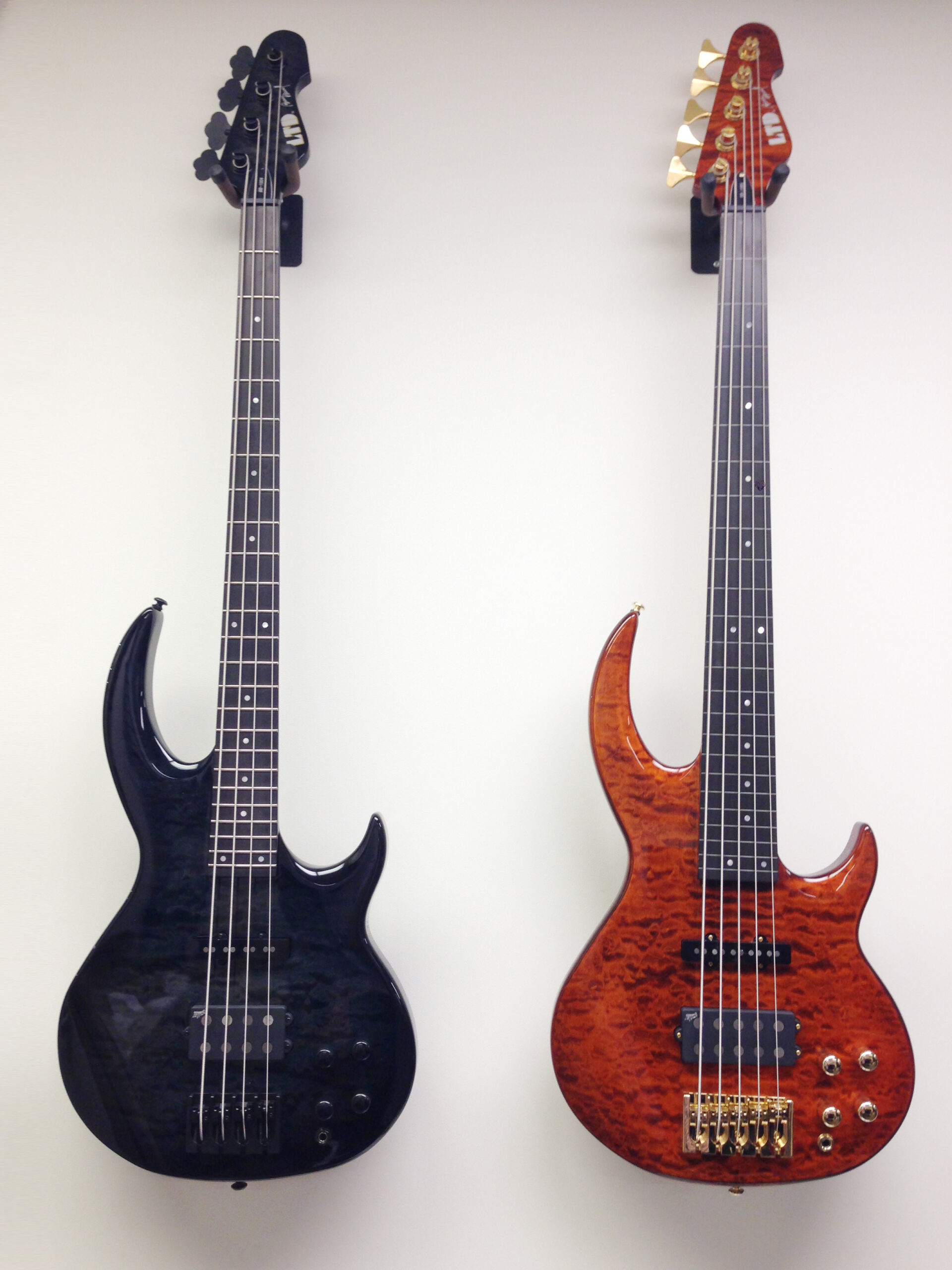
Bunny Brunel’s approach to the bass did not exist in isolation. As his instruments evolved—particularly in scale, tonal range, and fretless expression—they began to challenge the assumptions of standard bass hardware and accessories. Retailers, manufacturers, and technicians were often required to adapt in response, creating a secondary layer of innovation that extended beyond the instrument itself.
The emergence of extended-range response, highly sensitive fretless setups, and later the physical demands of instruments such as the electric upright bass (BBEUB), introduced practical considerations that conventional gear was not designed to accommodate. Cases, stands, amplification compatibility, and even string configurations required reconsideration.
In retail environments, Brunel-associated instruments frequently demanded specialized handling and display solutions. Traditional guitar stands and wall mounts were often insufficient—particularly for upright-style or uniquely balanced instruments. As a result, dealers and manufacturers explored more stable support systems and custom-fit storage options to ensure both safety and accessibility.
 String development also became a point of focus. Fretless playing, especially at Brunel’s level of articulation, places unique demands on string response, tension, and durability. Manufacturers were compelled to refine formulations to achieve greater consistency, smoother feel, and tonal balance, particularly across the midrange where expressive phrasing is most exposed. This period saw increasing collaboration between artists and string makers, reflecting a shift toward player-driven specification.
Amplification and signal clarity were similarly affected. Brunel’s emphasis on tone as a controlled, sculpted element—not merely an output—aligned with a growing demand for systems capable of reproducing subtle dynamic variation without compression or loss of detail. This influenced both boutique amplification design and the expectations placed on live and studio engineers.
Perhaps most significantly, the presence of instruments such as the BBEUB required a rethinking of portability and integration. Unlike traditional bass guitars, these designs introduced new challenges in transport, stage placement, and ergonomic support. The response from manufacturers and retailers underscores a broader reality: innovation at the instrument level inevitably reshapes the surrounding infrastructure.
As Brunel himself has emphasized in various discussions on tone and control:
“Everything is connected—the instrument, the strings, the amplification. You can’t separate one from the other.”
(Derived from clinic discussions and Bass Player Magazine interview themes)
This interconnected view is essential to understanding his impact. The legacy is not limited to signature models or tonal vocabulary—it extends to the systems built around them. In this sense, Brunel’s work contributed not only to how the bass is played, but to how it is supported, presented, and ultimately understood within the modern musical environment.
Bunny Brunel’s instrument designs, particularly his introduction of an asymmetrical neck for improved ergonomics, required manufacturers to adapt CNC processes while driving the development of specialized accessories like custom-molded flight cases. Furthermore, his partnership with La Bella strings to create a signature series was essential in achieving the required tension and smooth feel for his highly articulated, vocal fretless style.