Carvin: Where the Modern Bass Voice Was Defined

Carvin: Where the Modern Bass Voice Was Defined
Over 25 years of design evolution, engineering refinement, and artist-driven innovation shaped the BB Series into one of the most significant chapters in modern bass history.
“The bass has to respond to every nuance of your touch. It’s not just about notes—it’s about expression.”
Bunny Brunel design philosophy, reflected in clinics and interview themes
“You have to create the sound you hear in your head. The instrument has to give it back to you.”
Bunny Brunel on tone and instrument design, recurring workshop theme
“Everything is connected—the instrument, the strings, the amplification. You can’t separate one from the other.”

Bunny Brunel Basses: Carvin/Kiesel
Bunny Brunel on the complete bass ecosystem, clinic philosophy
Bunny Brunel’s relationship with Carvin stands as the most significant chapter in his instrument design legacy. Spanning more than 25 years, this was not a simple endorsement deal, nor was it a passive signature arrangement. It was a sustained collaboration that transformed both the artist and the company. During this period, Brunel was not merely associated with Carvin; he became central to its emergence as a high-performance bass manufacturer.
The development of the BB Series marked a turning point. What began as a niche instrument associated with fusion players evolved into a widely recognized benchmark for professional bass design. That transformation was driven by two forces working together: aggressive marketing and relentless technical refinement. Throughout the 1990s and early 2000s, the BB Series appeared prominently in the back covers of Bass Player and Guitar Player, often presenting Brunel alongside technical diagrams of the bass itself. Those advertisements did more than promote an artist—they presented the instrument as an engineered solution. The asymmetrical neck, neck-through construction, and extended top horn were treated as functional design answers rather than cosmetic features.
The Marketing Shift
Carvin understood that Brunel’s image could do more than sell a product. It could help reposition the company. The BB Series campaigns framed Brunel not only as a performer, but as a designer and problem-solver. High-profile collaborations with players such as Stanley Clarke and Tony MacAlpine reinforced that image, particularly in settings where the BB75 and BB76 had to prove themselves in dense, virtuosic, high-gain contexts. Carvin was no longer presenting a bass for a narrow audience. It was presenting a bass built to meet the demands of the modern professional.
This mattered because the design itself was addressing real limitations. Brunel’s concept of the ideal instrument was rooted in practical concerns—balance, fatigue, and clarity. The BB Series was not refined in the abstract. It was refined in response to actual performance conditions.
The Physical Design

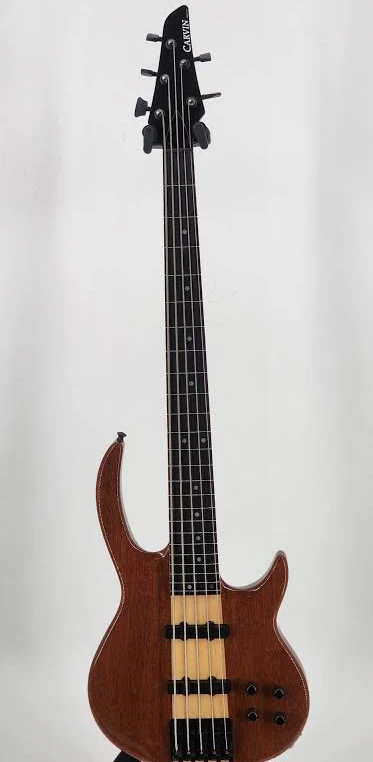
BB75: Bunny Brunel Signature Carvin/Kiesel
The earliest phase of the BB Series, including the BB70 and BB75, established the physical foundation. One of the most distinctive features was the extended top horn, which was weighted and proportioned to allow the bass to sit at approximately a 45-degree angle without the player having to support the neck. This was a radical ergonomic solution at the time. It addressed the imbalance that often made extended-range basses physically tiring to play, especially during long performances.
From there, Brunel pushed deeper into ergonomics with one of the most important design innovations of the Carvin period: the asymmetrical neck profile. By making the treble side thinner and the bass side fuller, the neck followed the natural mechanics of the hand. That design was especially important on the five-string BB75 and six-string BB76, where traditional neck profiles could be uncomfortable or even discouraging. In practical terms, the asymmetrical neck reduced fatigue while making technically demanding playing more accessible.
The Electronic Shift
 As the instruments evolved, electronics became a defining part of the Carvin sound. The BB Series moved beyond standard J-style pickups into a more advanced architecture built around H50S stacked humbuckers and an 18V active/passive preamp. This was not just about boosting output. It was about headroom, control, and the ability to shape tone with precision.
The semi-parametric mid-sweep control was especially important. Unlike a standard bass EQ, it allowed players to target the exact frequency area where the fretless “mwah” lives—typically between 400Hz and 800Hz. For Brunel, whose fretless voice depended on vocal articulation and the ability to cut through dense mixes without losing warmth, this was essential. The result was what many players came to recognize as the “Brunel growl”: punchy, articulate, and unmistakably present without becoming harsh.
The H50S stacked humbuckers also solved a critical problem. Traditional single-coils could introduce noise in studio environments or high-gain live settings. Carvin’s stacked design delivered a quieter signal path, which was crucial for players working in detailed, fusion-oriented contexts where every nuance had to remain audible. The active/passive push-pull option provided another layer of practical intelligence, giving touring players a reliable fallback if batteries failed while still preserving tonal flexibility.
Wood, Response, and the Fretless Voice

Carvin Museum: Bunny Brunel Designs
Brunel’s influence extended into wood selection and visual presentation as well. During the Carvin years, he helped popularize the use of Koa, Walnut, and Spalted Maple tops. These choices were not made simply for appearance. Brunel was attentive to density, resonance, and sustain—qualities that mattered deeply in fretless playing, where the relationship between touch and response is exposed. Combined with an ebony fingerboard, these woods helped produce the singing quality that became central to his fretless identity.
In this sense, the instrument was being refined on multiple levels at once. The body solved balance. The neck solved fatigue. The electronics solved clarity. The woods shaped the response. Each development was part of a larger pursuit: removing anything that interrupted the connection between the player’s intention and the resulting sound.
The Supporting Ecosystem
 As Brunel’s basses evolved, the surrounding ecosystem had to evolve with them. His instrument designs, particularly the asymmetrical neck and the specialized requirements of his fretless playing, pushed beyond standard production assumptions. Manufacturers had to adapt CNC processes to execute those shapes consistently, while retailers and accessory makers had to respond to demand with more specialized support products.
Custom-molded flight cases became increasingly important for protecting high-end, neck-through instruments during touring. Standard off-the-shelf solutions were often not enough. Retailers also had to accommodate instruments that were not designed to behave like conventional basses in either feel or setup.
Strings were another critical frontier. Brunel’s partnership with La Bella was essential in achieving the tension, articulation, and smooth feel required for his highly vocal fretless style. His sound depended on strings that would support nuance without fighting the fingerboard, and that collaboration reflects how deeply his design vision extended beyond the instrument itself.
The Professional Proof
The Carvin era was validated not only in ads and design specs, but in recorded work. Albums such as CAB (1999) and CAB 2 (2001), featuring Tony MacAlpine and Dennis Chambers, demonstrated the articulate, punchy, highly controlled sound of the BB75 in complex fusion settings. Dedication (1994) highlighted the sustain and singing quality of Brunel’s fretless approach, while projects such as Invent Your Future (2015) placed his Carvin instruments in experimental and collaborative contexts that demanded both stability and sophistication.
These recordings did what advertising alone could not. They proved that the design philosophy worked under pressure. The instruments were not theoretical achievements; they were battle-tested tools capable of meeting the demands of real music at a high level.
The Defining Chapter

Bunny Brunel and His Signature Carvin Bass, and Amp.
By the end of this 25-year collaboration, the impact of the BB Series had extended well beyond Carvin. Features that once seemed experimental—such as asymmetrical necks, ergonomically balanced long-horn bodies, and advanced active/passive systems—had entered the broader language of professional bass design. What began as a specialized solution for one artist became a reference point for the industry.
The Carvin years were defined by a pursuit of what might best be called the uninterrupted signal: a design philosophy in which nothing stands between the player’s intent and the speaker. Through iconic campaigns, rigorous engineering, and real-world musical proof, Bunny Brunel helped define what the modern bass could be.
Final View
The Carvin era was not merely the longest partnership in Bunny Brunel’s design story. It was the chapter in which his ideas matured into a complete system—ergonomic, electronic, aesthetic, and musical—and, in doing so, helped shift the expectations of the modern professional bassist.