The Founding Four: Where It Began
A look back at the moment the bass stepped forward and never went back
By Bunny Brunel
Watching Virtuoso Bass Issue 4: The Founding Four come together felt like watching time fold back on itself, an evolution of our careers and a reminder of how it all began. We did not have a roadmap. There was no system, no online exchanges, no shared language for what we were trying to do. We were each, in our own corners, searching and pushing the instrument beyond its role, trying to make the bass sing, speak, and lead. We were building something that did not yet have a name.
For me, it was always about the sound. That perfect sound. A tone that could carry the melody, sustain a solo, and still hold the groove with authority. That meant working closely with luthiers, refining instruments, and experimenting constantly, often without precedent. There was no manual. Only the ear, the instinct, and the pursuit. That same pursuit connects the four of us.
Stanley Clarke, Jaco Pastorius, Jeff Berlin, and myself were not following a movement. We were creating one. Each of us came from a different musical direction, but we shared the same objective, to bring the bass forward as a true voice. Stanley brought the instrument into a new level of visibility with his command of both upright and electric bass, giving it a soloist’s authority on the world stage. Jaco changed the language with the fretless bass, introducing a singing quality that redefined phrasing, tone, and articulation. Jeff approached the instrument with precision and clarity, reinforcing that technique must always serve the music while establishing a standard that would influence generations. My own path centered on tone and harmonic expansion, developing a sound that could support complex compositions while remaining melodic and expressive within the harmony.
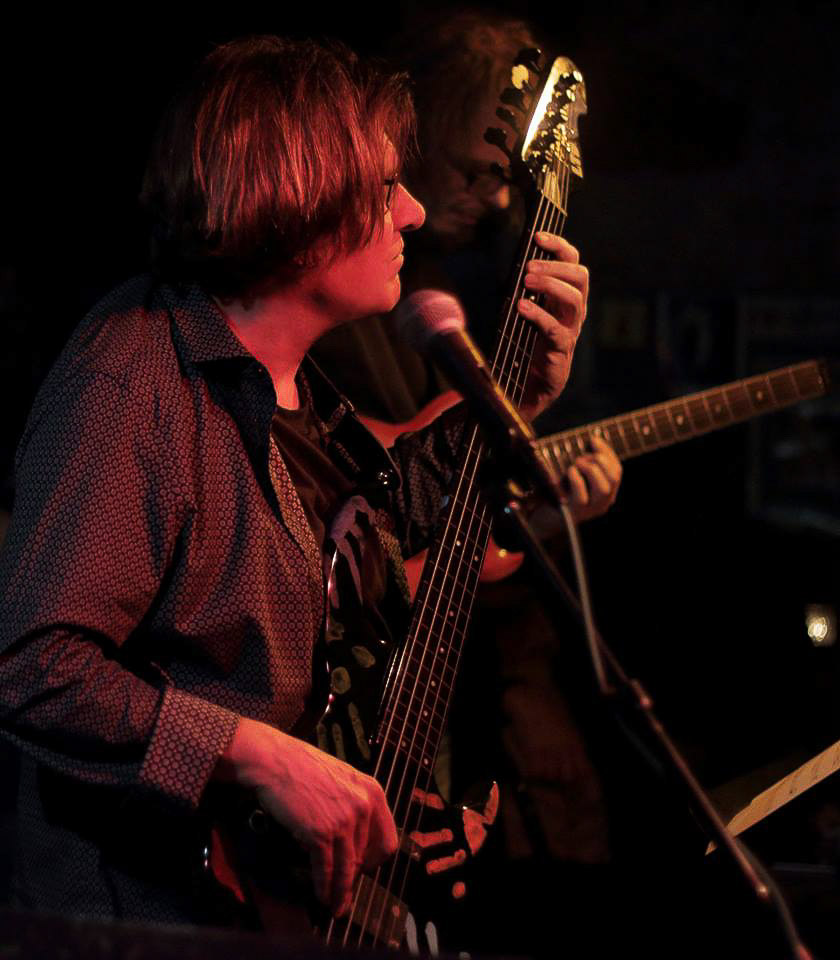
Bunny Brunel playing his latest design, a Bunny Brunel Signature 5-string Fretless Bass with his daughter’s hand prints. (Photo by Devino Tricoche)
What ties all of this together is that none of it was coordinated. We were not exchanging ideas or building a collective in the way people might imagine today. We were discovering these concepts independently, driven by the same need to expand the role of the instrument. That is why this is a canon. Not because it was declared, but because it happened.
The emergence of jazz fusion created the space for that evolution. The music demanded more from every instrument, more harmonic movement, more rhythmic complexity, and more interaction. The bass could no longer remain in a strictly supportive role. It had to move forward into melody, into soloing, into composition, and into leadership. What followed was not just a change in playing style, but a shift in expectation. The next generation inherited an entirely different instrument in a musical sense, with expanded vocabulary, expanded responsibility, and expanded possibilities.
Today, players have access to everything, information, technique, recordings, and education. At that time, all we had was the music and the conviction that the bass could be more. That conviction built the foundation.
The Founding Four is not about looking back with nostalgia. It is about recognizing a moment when the instrument changed direction and understanding how that change continues to resonate. I also want to acknowledge the work behind the scenes. My thanks to the research team at KL Publishing Group for their tireless effort in organizing and presenting this history with clarity and purpose. What you see in this issue is the result of careful study, verification, and respect for the music and its origins.
This issue lays the foundation, but it does not end here. There is a deeper story that reaches back to the late 1970s, when these ideas were already taking shape. In conversations with Patrick Moraz, the concept of what would become the canon, along with the recognition of the Founding Four, was being defined in real time from within the movement itself. That perspective will be explored in full in the forthcoming Virtuoso Bass Canon book, a comprehensive work that expands on what is introduced here with greater depth and context. The magazine presents the framework. The book will take you inside it.
Tags
Bunny Brunel, Stanley Clarke, Jaco Pastorius, Jeff Berlin, jazz fusion, electric jazz, bass guitar, Virtuoso Bass, The Founding Four, bass canon, jazz history, fusion bass, instrumental music, bass innovators, modern bass, music legacy