The Alembic-Gibson Experiment
How the Alembic Philosophy Shaped a Design Legacy
Bunny Brunel’s involvement with Alembic sits at the intersection of technical experimentation and tonal refinement—a moment when the electric bass was still defining its identity in jazz fusion. Rather than a formal brand endorsement, his relationship with Alembic was that of a visionary player utilizing boutique components to “hot-rod” the industry standard. Alembic, synonymous with high-end craftsmanship and active onboard electronics, provided the conceptual toolkit for Brunel’s evolving melodic language.
“I think the idea is to learn as much technically as you can, then forget it so that you can be creative.” —Bunny Brunel, Abstract Logix
The most tangible evidence of this philosophy was the 1986 Gibson Bunny Brunel Signature prototype. While the instrument was built by Gibson, Brunel specifically engineered it to house Alembic active pickups and a multi-filter preamp. This wasn’t merely about high output; it was about precision. Brunel famously utilized an Alembic tone pot that functioned with the sweep of a wah-pedal, allowing him to “vocalize” his fretless lines with a level of articulation that standard electronics could not provide. This underscored a foundational principle he would carry into all his future designs: that tone is not incidental—it is engineered.
On His Role as a Designer
Brunel views his designs as a bridge between his practical experience as a player and the precision of engineering:
Brunel views his designs as a bridge between his practical experience as a player and the precision of engineering:
“I was first approached by the Yamaha company to help them with their line of basses: The BB series, especially the BB3000 is the one that they were doing for me.”“Being a player, I really understand how the instrument should be made—the balance, the weight, the pickups, etc. I really spent some time to find the best way to make it.”
In this period, Brunel was already moving toward the signature fretless voice that would define his career. The sustain and sensitivity of the Alembic circuitry allowed him to explore phrasing rooted in his classical training at the Nice Conservatory, bridging the gap between acoustic upright sensibility and electric projection. While he never moved into long-term signature production with Alembic, the influence of their “high-fidelity” approach is unmistakable. This emphasis on electronic control and tonal flexibility became the blueprint for his subsequent work with Yamaha.
Yamaha and the “Bunny Brunel” Bass
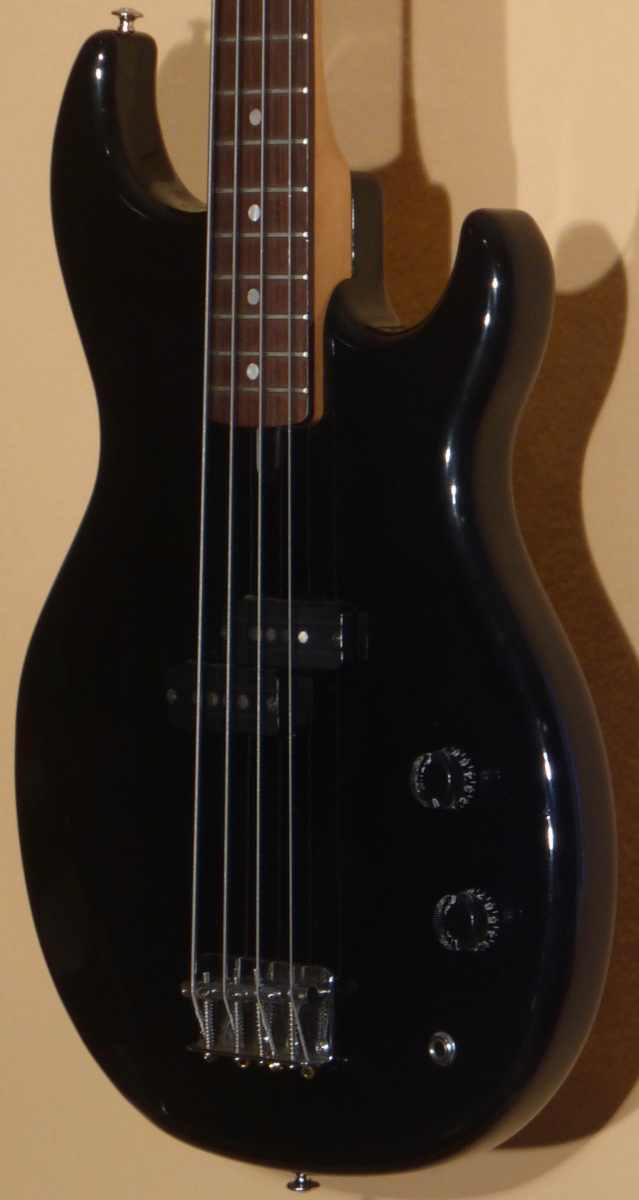
The 1984 Yamaha BB300 is often affectionately referred to in the musician community as the “Bunny Brunel” model. While Bunny himself primarily focused his design efforts on the high-end, neck-through BB3000, the BB300 was the affordable, bolt-on sibling that brought that same design ethos to a wider audience.
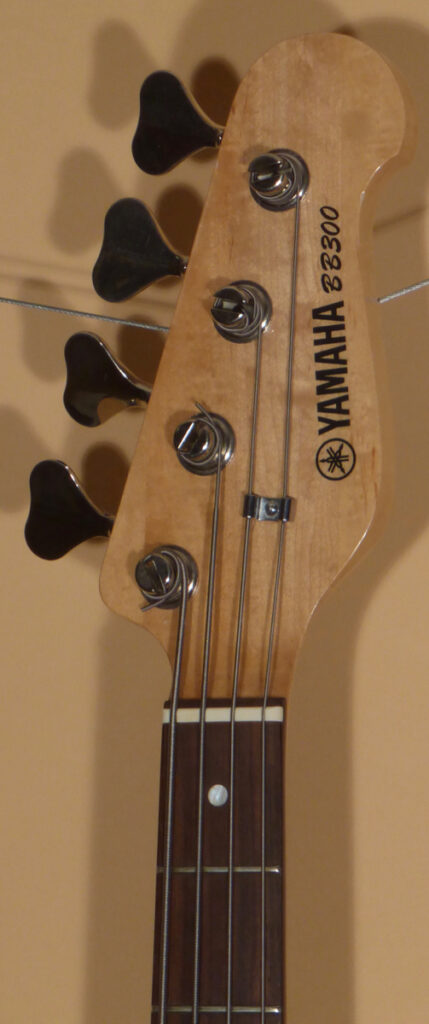 The “Bunny Brunel” Connection
Although it was marketed as a budget-friendly alternative to the flagship models, the BB300 earned its reputation as a “player’s bass” for several reasons:
- Design Influence: It shares the same body contours and iconic silhouette that Brunel helped refine for the BB series.
- The “Fast” Neck: Fans of this model specifically praise its thin, fast neck profile, which was a key requirement Brunel had for the more expensive
- Simplicity: Unlike the complex active systems he later explored with Alembic and Gibson, the BB300 is a straightforward passive machine with a single split-coil pickup, known for its “thick tone” and reliability.
1984 Specifications
By 1984, the BB300 was a staple in Yamaha’s expansion era.
BassBros
- Construction: Bolt-on maple neck with a rosewood fingerboard.
- Body: Typically made of Nato (a wood similar to mahogany), whereas higher models used Alder or Maple.
- Hardware: Vintage-style chrome bridge and open-gear tuners.
- Pickups: A single high-output split-coil (P-style) pickup.
Greg Boyd’s House of Fine Instruments
Bunny Brunel Electric Upright Bass (BBEUB)
This era also served as the essential R&D for his later masterpiece, the Bunny Brunel Electric Upright Bass (BBEUB). By mastering active filters in the 80s, Brunel was uniquely prepared to solve the “feedback and flight” problems of the upright, eventually creating a portable instrument that finally captured the authentic 50-cycle attack of a traditional double bass.
The Professional Flight System
Understanding that the greatest “problem” with a traditional upright is its vulnerability during travel, Brunel designed a proprietary transport system. The BBEUB comes with a custom-molded flight case that is significantly more compact than a standard bass trunk.
- Dimensions: The case is approximately 67″ x 10″ x 8″, designed specifically to fit into the “oversized” luggage category or, in many cases, to be checked as a “fragile instrument” with a much lower risk of damage due to its solid mahogany core.
- Protection: The interior is plush-lined with high-density foam inserts that secure the neck and bridge, ensuring the bass arrives in tune and ready to play even after international transit.

BBEUB: Bunny Brunel Electric Upright Bass (Photo by Arun Nevader)
The Adjustable Height & Ergonomic Support
Unlike fixed-height electric uprights, the BBEUB features a heavy-duty adjustable endpin system. This allows the player to set the “nut height” exactly where they would on a standard 3/4 acoustic bass, preserving muscle memory for players who switch between the two.
- Bout Attachment: To mimic the physical feel of a large acoustic body against the ribs, the BBEUB includes a removable “body rest” or bout. This allows the player to “lean” into the bass during aggressive thumb-position playing, providing the physical leverage necessary for traditional upright techniques without the bulk of a hollow body.
The BBEUB represents the culmination of Brunel’s design philosophy: a marriage of Russ Ali’s legendary electronic engineering and Bunny’s own practical requirements as a world-touring artist. By utilizing Eony Makasar for the fingerboard and a feedback-resistant mahogany body, the instrument offers the “vocal” quality of a traditional bass with the reliability of a solid-body. Whether on display at SIR Studios or in the hands of Stanley Clarke, the BBEUB remains a masterclass in solving the physical and sonic limitations of the upright bass, making it a “must-have” tool for the modern fusion professional.