Bunny Brunel in Africa
Touring with Georges Moustaki then Chick Corea
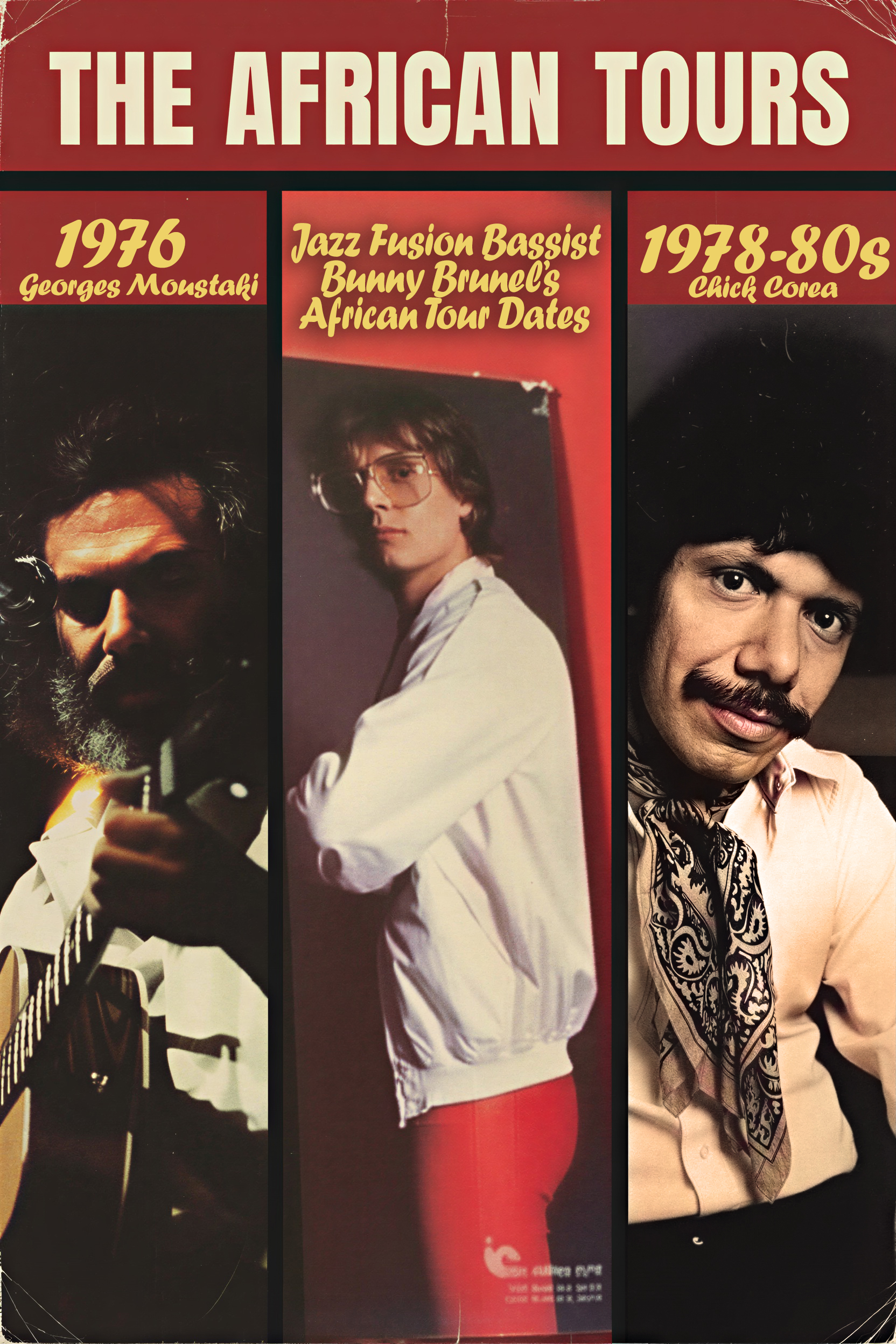
Bunny Brunel’s early international career placed him within the global touring circuits of the late 1970s and early 1980s, particularly through his work with Georges Moustaki and Chick Corea.
Touring with Georges Moustaki
As musical director for Moustaki, Brunel participated in extensive international touring. Moustaki’s popularity throughout Europe and the Francophone world extended into regions of Africa, where his music resonated deeply with local audiences.
While detailed archival records of specific African tour dates remain limited, Brunel has described these performances as large-scale engagements, often in regions where audiences were intimately familiar with Moustaki’s repertoire. In this role, Brunel was responsible for shaping the musical direction of the performances, blending Moustaki’s chanson and world-music influences with more advanced harmonic and rhythmic structures.
In later reflections, Brunel has noted that exposure to African rhythmic traditions during these travels left a lasting impression on his approach to time, phrasing, and groove—elements that would become central to his voice in jazz fusion.
Touring with Chick Corea (1978–early 1980s)
Brunel’s association with Chick Corea began in 1978, leading to international touring during a highly experimental period in Corea’s career. These tours, tied to projects such as Secret Agent (1978) and Tap Step (1980), brought together a dynamic lineup that often included drummer Tom Brechtlein, with additional percussionists such as Airto Moreira and Don Alias appearing in various configurations.
Brunel has recalled that performances in rhythmically rich regions—including parts of Africa—were particularly impactful. Rather than a one-directional presentation of jazz, he describes these experiences as a form of exchange, where the audience’s deep-rooted connection to rhythm influenced the band’s intensity and approach in live settings.
The rhythmic openness explored during this period is reflected in recordings such as Tap Step, where global influences and percussive interplay play a central role in the music’s structure.