Bunny Brunel and the Ze (Re) Tour Finale
When the Bass Conducted the Spectacle for Over 3 Million
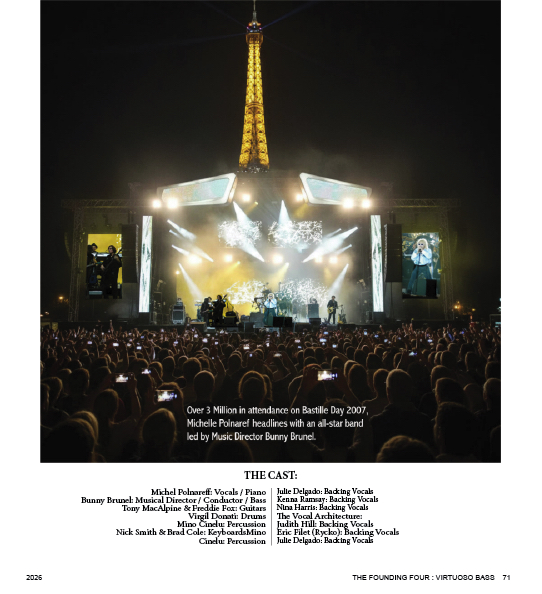
When Michel Polnareff returned to the stage in 2007 after more than three decades away, the Ze (Re) Tour redefined the scale of a comeback—playing to over 3 million people across its run. At its core was Bunny Brunel, serving as bassist, musical director, and architect of a production shaped from within the music itself. At the center of that spectacle stood Bunny Brunel—not simply as bassist, but as musical director, conductor, and the architect responsible for building and leading the band itself.
Official credits list Brunel as direction musicale et basses, but the footage reveals what that truly means. He is not removed from the stage, nor isolated as a conductor. He is embedded in the rhythm section—playing, cueing, shaping, and controlling the flow of the entire production from within the music itself. Every transition, every dynamic shift, every moment of precision passes through the same place: the groove. What becomes immediately clear—especially in the wide arena shots—is that Brunel’s role extends beyond sound. In multiple moments, he is projected onto the massive video screens towering above the audience. In a production where every visual cue is deliberate, this is not incidental. It is a statement. The camera does not simply follow the star—it reveals the engine. The bass, and the player behind it, are positioned as central to the experience, not hidden beneath it.
That level of authority begins long before the first note is played. Brunel didn’t inherit a band—he assembled one with intent. The lineup reflects a deliberate rejection of convention:
- Virgil Donati – drums
- Tony MacAlpine – guitar
- Mino Cinelu – percussion
- Brad Cole and Nick Smith – keyboards
This was not a standard pop backing group. It was a precision-built ensemble, capable of handling the complexity of arrangements that had to function simultaneously as music, spectacle, and cinematic narrative.
As explored in Virtuoso Bass Issue 4: The Founding Four, Brunel’s musicianship has always extended beyond performance into structure. The Ze (Re) Tour stands as a defining real-world expression of that philosophy—where the bassist becomes not only the foundation of the music, but the architect of an entire live system.
As Brunel explained in Virtuoso Bass Issue 4, the scale demanded more than performance—it required control:
“You have to be the anchor. When you’re standing on a stage that large, looking out at a sea of over a million faces, the stakes are completely different. My work as a music director usually comes out of necessity—artists need someone who can organize the chaos and make the arrangements make sense for a world-class band.”
That sense of control was not theoretical—it was built into the DNA of the band itself:
“I didn’t want a standard pop-rock backing group; I wanted a ‘supergroup’ that could bring a technical edge to Polnareff’s songs. I recruited Virgil Donati on drums and Tony MacAlpine on guitar—two of the most dangerous players I know.”
And at the core of it all, the role of the bass remains non-negotiable:
“As a bassist, you already understand structure because you’re holding the foundation of the music every night. If the bass chair falls apart, the whole million-person experience falls apart. We brought the complexity of fusion to the biggest stage in the world and proved that if you give an audience depth, they will stay with you.”
By the time the tour reached its filmed conclusion—following a 44-city run—the production had evolved into something far beyond a concert. Massive lighting environments, synchronized visuals, and tightly choreographed musical transitions created a system where nothing could drift. Every cue had to land with absolute precision. And it did.
The audience response captured on film is overwhelming—waves of light, sustained applause, a scale that transforms performance into shared experience. As Polnareff himself reflected on his long-awaited return:
“I waited a long time for this moment… to be back on stage in front of my audience.”
That moment—decades in the making—was carried by a structure strong enough to hold it. Brunel built that structure.
What this performance ultimately reveals is something rarely acknowledged in productions of this size: leadership does not always stand apart. Sometimes, it sits in the rhythm section—quietly directing the entire system from within.
The band does not follow the show.
The show follows the band.
And at its center is a bassist conducting an empire in motion—without ever stepping out of the groove.
Watch the concert: https://bunnybrunelofficial.com/js_videos/love-me-please-love-me-live-ze-re-tour-2007/