Biography
The Life, Music, and Legacy of a Jazz Fusion Bass Legend
Fusion Giant Bunny Brunel has spent more than five decades expanding the possibilities of the bass and helping shape the language of jazz fusion. A bassist, composer, arranger, producer, bandleader, educator, and instrument designer, Bunny emerged during fusion’s formative years with formidable technique, sophisticated harmony, and an unmistakable gift for melody. On fretless, electric, upright, or piccolo bass, he doesn’t simply anchor the music. He sings, improvises, harmonizes, converses, and leads. Born in the South of France, Bernard “Bunny” Brunel began on piano, playing jazz chords by ear before ever touching a bass. Guitar came next. Then fate intervened: as a teenager, Bunny was asked to rent a bass for a musician who never showed up for rehearsal. He picked it up himself. “That was the day I became a bass player—and I loved it!” He later attended the Classical Conservatory in Nice to study bowing technique while developing the individual style that would eventually take him around the world.
By his early twenties, Bunny was performing with Tania Maria at Ronnie Scott’s Jazz Club in London when Patrick Moraz introduced him to Chick Corea. Following Stanley Clarke’s tenure in Corea’s bass chair, Bunny entered a musical partnership with Corea that would span nearly a decade of touring and recording. His contribution went far beyond playing bass. He brought his skills as an arranger and multi-instrumentalist to iconic Corea releases including Secret Agent and Tap Step and appeared with Corea and Tony Williams on the live recording Live in the Sky. Corea later praised Bunny’s melodic approach to improvisation, the “singing feeling” of his lines, and his distinctive use of chords and guitar-like harmonies on bass. That musical journey would place Bunny alongside an extraordinary range of artists, including Herbie Hancock, Wayne Shorter, Tony Williams, Dizzy Gillespie, Stevie Wonder, Al Jarreau, Jack DeJohnette, and Natalie Cole, among many others. His recording and performance credits across jazz, fusion, and contemporary music are simply too extensive to contain in a single biography.
At the same time, Bunny was building a formidable catalog of his own. His 1978 debut, Touch, placed his fretless and electric upright playing at the center of music already unmistakably his. Ivanhoe followed in 1979, and Dedication, For You to Play, Invent Your Future, and numerous other recordings would follow. Then came CAB. Founded by Bunny, CAB became one of the defining vehicles for his vision of contemporary jazz fusion, with CAB establishing the group’s identity and CAB 2 earning a Grammy nomination for Best Contemporary Jazz Album. Grammy-nominated Bunny Brunel has also performed on the Grammy Awards stage, but awards and nominations tell only a fraction of the story.
Bunny Brunel and Friends’ Bass Ball brought together an extraordinary gathering of iconic bass players, including Billy Sheehan, Victor Wooten, Armand Sabal-Lecco, Hadrien Feraud, Dominique Di Piazza, Stanley Clarke, and many others. The historic recording was co-produced with Clarke. In 2017, Bass Ball 2, produced by Bunny, continued the series with Kyle Eastwood and Federico Malaman, while Stanley Clarke and Armand Sabal-Lecco returned for the second recording. The two albums also drew from an exceptional circle of music luminaries, with Larry Dunn appearing on both releases, alongside Simon Phillips, Patrice Rushen, and many others. However sophisticated the harmony or demanding the execution, Bunny never sacrifices the thing at the center of his music: a melody you remember.
Bunny is also a dynamic and commanding live performer. Virtuosity is only part of what happens when he takes the stage. He plays with an immediacy that pulls an audience into the music, moving between explosive fusion passages, melodic improvisation, humor, spontaneity, and intimate musical conversation. The bass becomes visual as well as musical in his hands: animated, expressive, unpredictable, and unmistakably alive. That command of an audience has carried him from intimate jazz clubs to enormous concert stages. As Musical Director, conductor, and bassist for Michel Polnareff’s Ze (Re) Tour 2007, Bunny helped drive a production that included the monumental Bastille Day performance at the Champ-de-Mars in Paris. The production went on to receive the 2008 Victoire de la Musique for Musical Show, Tour, or Concert of the Year, one of France’s major national music honors. Bunny’s own philosophy about performing is far less complicated: “Whether you’re playing to 100 people or three million, always give the best performance . . . that’s what fusion is all about; excellence at the highest level!”
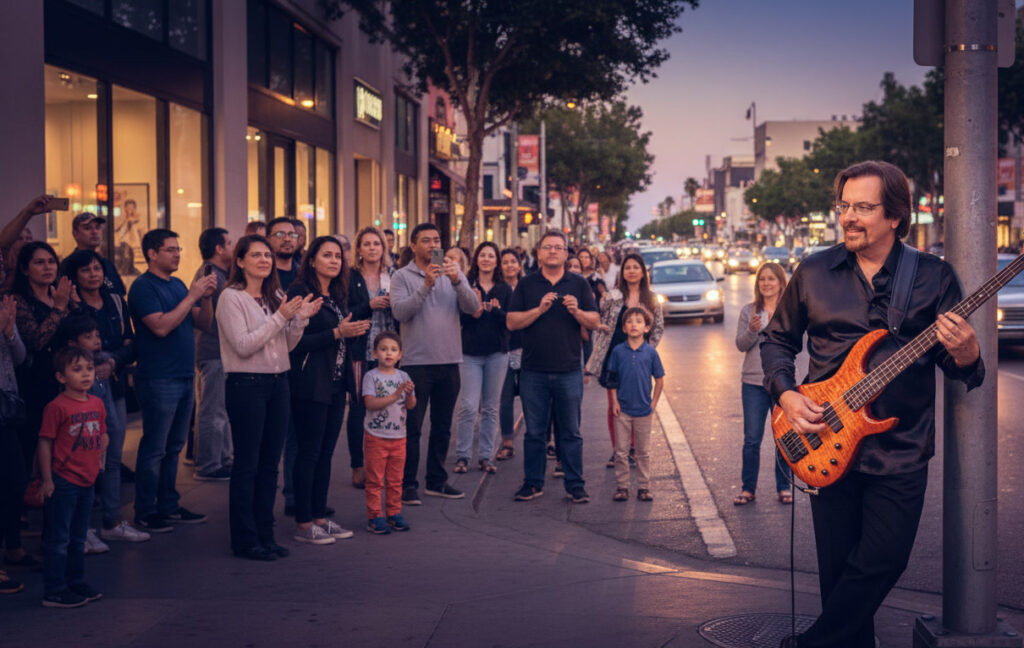
Bunny Brunel entertains the crowd, introducing them to jazz fusion. They loved it! (Photo: First Take PR Photography)
His influence on the instrument extends far beyond the stage and recording studio. For more than 25 years, Bunny designed instruments for Carvin before continuing his work with ESP Guitars, and he created and custom-built the Bunny Brunel Electric Upright Bass (BBEUB). His designs reflect a working virtuoso’s understanding of tone, balance, response, and playability, while his numerous instructional books on bass technique and theory have carried that knowledge to generations of musicians. Bunny has also taught players who went on to major careers of their own, including Kyle Eastwood, Jason Scheff, and Marco Mendoza. Eastwood has publicly credited Bunny with teaching him both classical and jazz bass. For Bunny, teaching, writing, and instrument design are not separate sidelines; they are extensions of the same musical philosophy that has guided his playing, continually challenging assumptions about what the bass can do and where it belongs in the music.
His musical reach also extends powerfully to the screen. Bunny has scored for film and collaborated and performed on the theme associated with Clint Eastwood’s Academy Award-winning Unforgiven. He also collaborated with legendary composer Henry Mancini on Son of the Pink Panther, Mancini’s final film score, where Bunny played a critical role in reshaping the sonic identity of an iconic franchise. His approach to the bass was not merely supportive but conversational. He treated it as a lead voice, capable of wit, nuance, and narrative presence. That approach reaches far beyond a single film score. It is fundamental to the way Bunny has approached the instrument throughout his career: the bass can establish the foundation, but it can also speak, answer, provoke, sing, and tell the story.
The music press has chronicled that career extensively. Bunny has appeared on the covers of Virtuoso Bass, Bass Musician, Bassics, Bassiste, Bass Frontiers, and Plug N Play and has been featured in Bass Player, JazzTimes, No Treble, For Bass Players Only, Abstract Logix, Fretless Bass, Guitar 9, Global Bass Online, and TalkBass, among others. He is also a featured columnist for Jazz Influencers and serves as Editor at Large of Virtuoso Bass. Bass Musician Magazine placed him on its “very short list” of world-class bassists who have achieved legendary status and pushed the limits of the instrument. In 2024, Bunny received an Olympia Arts Award, another recognition in a career that has encompassed landmark recordings, Grammy recognition, celebrated performances, film, education, instrument innovation, and an extraordinary body of work.
For all the virtuosity, recordings, famous collaborations, stages, film scores, instrument designs, books, awards, and miles traveled, the thread running through Bunny Brunel’s career has never changed: melody. It is what Chick Corea heard decades ago. It runs from Touch through CAB and Bass Ball 2. It is there when Bunny turns the bass into a conversation, commands an enormous stage, or makes formidable technique sound effortless. Even amid profound harmonic changes and demanding execution, the listener walks away humming his tunes. Bunny Brunel doesn’t simply play jazz fusion. He helped build its language—and he’s nowhere near finished speaking it.