Bunny Brunel — For You to Play (1994)
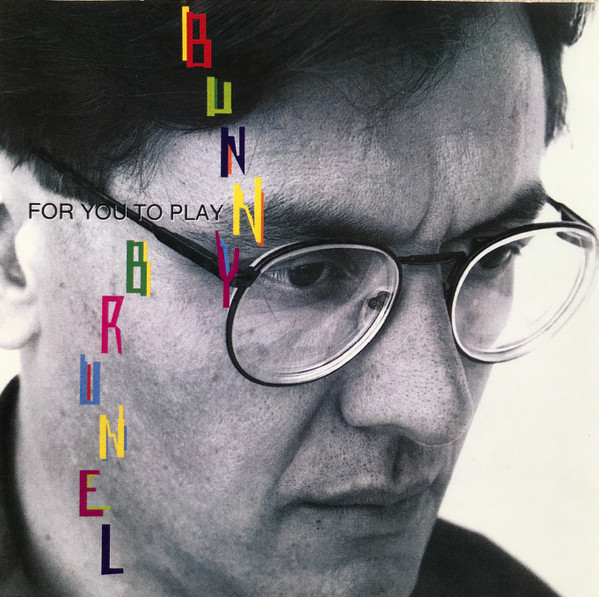
By the mid-1990s, jazz fusion was at a crossroads. The explosive experimentation of the ’70s had given way to increasingly polished, often restrained interpretations of the genre. In the midst of this shifting landscape, Bunny Brunel delivered a statement that was both deeply rooted in tradition and quietly revolutionary. For You to Play, recorded at Mad Hatter Studios, is not merely a showcase of technical command—it is a redefinition of the electric bass as a lyrical, front-line instrument.
At the heart of the album is Brunel’s unmistakable fretless voice. Utilizing his Carvin BB75 and an advanced three-finger right-hand technique, he achieves a fluid, vocal-like articulation—the signature “mwah” tone—that moves beyond accompaniment and into melodic leadership. Rather than functioning as a traditional rhythmic anchor, Brunel shapes phrases with the nuance of a horn player, allowing the bass to carry thematic material with clarity and emotional weight. This approach places For You to Play in a rare category of fusion recordings where the bass is not supporting the narrative—it is the narrative.
The sessions are elevated by a cast of exceptional musicians who meet Brunel on equal footing. Mike Stern contributes his unmistakable harmonic language—blues-inflected, fluid, and rhythmically elastic—bringing a conversational interplay that pushes the music forward without overwhelming its structure. On keys, Billy Childs provides harmonic sophistication and orchestral depth, grounding the compositions while expanding their tonal palette. The result is a balanced, highly responsive ensemble where virtuosity serves musicality, not the other way around.
Personnel (Core Lineup & Featured Artists)
- Bunny Brunel — fretless bass, fretted bass, compositions
- Mike Stern — electric guitar
- Billy Childs — piano, keyboards
- Additional supporting musicians (drums, rhythm section) contribute to the album’s cohesive yet flexible framework, allowing Brunel’s lead voice to remain central while maintaining dynamic interplay.
Musical Highlights & Innovations
What distinguishes For You to Play is not simply its technical execution, but its architectural clarity. The compositions are built with intention—melodic lines are allowed to breathe, harmonic progressions unfold with logic, and rhythmic structures support rather than dominate. Brunel’s phrasing consistently prioritizes direction over density, resulting in music that is both sophisticated and accessible.
A defining characteristic of the album is its restraint. In an era increasingly defined by speed and complexity for their own sake, Brunel opts for phrasing that serves the composition. His lines sing, bend, and resolve with a sense of inevitability, demonstrating that virtuosity can be most effective when it is felt rather than displayed. This philosophy places the album in alignment with the lineage of great melodic innovators while still firmly rooted in modern electric fusion.
Equally important is the sonic environment. Recording at Mad Hatter Studios—long associated with Chick Corea—imbues the album with a sense of legacy. There is an audible continuity between the exploratory spirit of earlier fusion movements and Brunel’s forward-looking approach. The production is clean yet warm, allowing every nuance of articulation and interaction to remain intact.
Legacy & Significance
For You to Play stands as a pivotal entry in Brunel’s discography and in the broader evolution of fusion bass. It bridges two essential ideas: the technical advancements of electric bass playing and the enduring importance of melody. In doing so, it expands the instrument’s role without abandoning its foundational responsibilities.
More importantly, the album anticipates a shift that would become increasingly evident in later projects, including Brunel’s work with CAB. The concept of the bass as a lead, compositional force—fully integrated into the identity of the ensemble—finds one of its clearest early expressions here. It is not an exaggeration to view For You to Play as part of the developmental arc that would eventually lead to the high-intensity, fully realized fusion language of the 2000s.
In a catalog defined by innovation, For You to Play remains one of Brunel’s most refined and forward-thinking statements—an album where technique, tone, and musical vision converge with uncommon precision.
For You to Play was originally released under the French label
(catalog number MDCD 317). It was also issued as a reissue by Nikaia Records that same year.